skilj 0.2.0: access is something you hold
Capabilities, an access trail and keys that stay out of the process

I tagged skilj 0.2.0 today. It's a breaking release, which is what the 0.x number is for, and its theme is that access is now something you hold, not something you happen to be called. The rest of this post explains what that means, and why a library that restricts itself to pure decisions makes it a lot easier to get right.
In short:
- Capabilities replace Role names. A grant opens a gated projection or field only by holding the capability. Nothing implies one, not even being a superadmin.
- Every change to access is an event, written in the same transaction, so "what could this grant do on that date?" has an answer.
- The master key lives at a key provider, and deleting a tenant can be a cryptographic erasure.
One at a time, and only if it fits
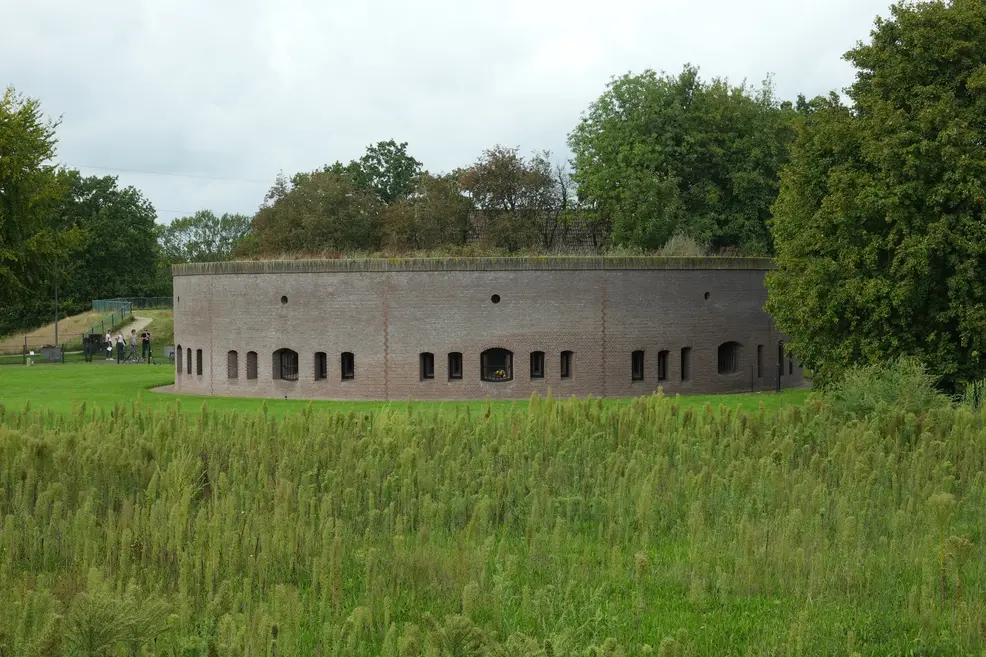
The photo at the top is a bridge in Molenhoek, in the Netherlands, and it's the picture I have in my head for how skilj handles a command. One car at a time, and only if it fits. There's a width limit, and it's signposted three times. Drivers keep testing it anyway: a Land Rover got stuck fast (Dutch), NOS counted at least ten vehicles in one week (also Dutch), and in an English translation of a local report a caravan was the ninth to try. The bridge doesn't negotiate, and neither does skilj.
One at a time is the first half. All the commands of a bounded context are decided under one Postgres row lock, so two people racing for the last seat don't both get it. Only if it fits is the second half: the decision is made against exactly the events the command shares tags with, and the answer is yes or no. (I wrote about how that works in Why skilj has no aggregates.)
What I want to point at today is the thing in the middle, the decision itself. Here is the withdrawal from the wallet example in the template, trimmed a little:
That is all your code gets to do. It receives the payload and the events that share the command's tags, and it answers with a rejection or with the events to append. It's a plain synchronous function: no database handle, no network, no clock, no idea who is calling. (Rust won't stop a function from opening a file if it really wants to. The point is that the signature gives it nothing to hold on to.)
I did that on purpose, and it pays off in four ways.
It's safe to run twice. skilj decides optimistically and then again under the lock if the first
attempt raced with something. If decide() sent an email, that would be a bug. Because it can only
compute, running it again is merely wasteful.
The part an AI writes is small. In Skyhooks, cranes and a library I didn't write I admitted that Claude wrote much of skilj. Application code may well go the same way, and a decision function is the best possible thing to let a model write: the whole of it fits on one screen, it can't leak anything it can't see, and you can read it without understanding the rest of the system.
It can't be talked out of the checks. The order of the pipeline is not up to the decider. Below is
what happens to a command. Everything before decide() is the library's job, and an unauthorised caller
never reaches it.
It's trivial to test. Events in, decision out. No Postgres, no mocks. For the cases where you do want the real thing, there's a dry run that authorises like a normal submission and reports what the decision would be without writing anything.
Green means allowed, red refused, and yellow is held back or hidden. The diagrams are simplified from
docs/authorization.md, which has
the complete set.
flowchart TD
    IN(["A command arrives
(JWT or id.secret token)"]):::start --> AUTH{"Authenticated, and allowed
to submit this command?"}:::decision
    AUTH -- no --> DENY["Refused.
decide() never runs"]:::deny
    AUTH -- yes --> IDEM["Check the idempotency key"]:::step
    IDEM --> POLICY{"Does the command type
need approval?"}:::decision
    POLICY -- yes --> PROPOSE(["Stored as a proposal.
decide() runs at approval"]):::hide
    POLICY -- no --> LOCK["Lock the bounded context, read the
events sharing the command's tags"]:::step
    LOCK --> DECIDE{"decide(payload,
matching events)"}:::decision
    DECIDE -- Rejected --> REJ(["accepted: false,
with a reason"]):::deny
    DECIDE -- Accepted --> WRITE["Append the events, encrypt sensitive fields,
update projections: one transaction"]:::step
    WRITE --> DONE(["accepted: true"]):::allow

    classDef start fill:#1f4e79,stroke:#7fb3e6,color:#fff
    classDef decision fill:#3a3a5c,stroke:#9a9ad0,color:#fff
    classDef step fill:#2d3748,stroke:#718096,color:#fff
    classDef allow fill:#1e6b3a,stroke:#6fcf97,color:#fff
    classDef deny fill:#8b2635,stroke:#f2868f,color:#fff
    classDef hide fill:#6b5a1e,stroke:#e6c76f,color:#fff
Two ways in, two kinds of token
Everything that happens before decide() depends on who is calling, so it helps to know the two ways in.
People and services that use the application come in over GraphQL with a JWT from your identity provider,
which resolves to a Role and its grants. Narrow agents and automated callers come in over REST with an
id.secret token that is scoped to exactly one registered type, and optionally to one owner. An agent
that handles refunds can ask for refunds for that customer, and nothing else.
flowchart LR
    subgraph GQL["GraphQL: HTTP and WebSocket"]
        direction LR
        JWT["Bearer JWT
signed by your IdP"]:::step --> ROLE["Role
matched on external_subject"]:::step
        ROLE --> GRANT["RoleAccessMapping
level, scope, capabilities"]:::step
    end
    subgraph RST["REST"]
        direction LR
        TOK["Bearer id.secret"]:::step --> AT["AccessToken
one type, optional owner scope"]:::step
    end
    GRANT --> BC[("Bounded context
events, commands, projections")]:::store
    AT --> BC
    SUPER(["Superadmin"]):::start -. "creates Roles,
bounded contexts, grants" .-> GRANT
    ADMIN(["Admin grant"]):::start -. "mints and revokes" .-> AT
    ADMIN -. "registers types" .-> BC

    classDef start fill:#1f4e79,stroke:#7fb3e6,color:#fff
    classDef step fill:#2d3748,stroke:#718096,color:#fff
    classDef store fill:#4a2d6b,stroke:#b79ae0,color:#fff
The second track is the keyhole I described in the security post. What 0.2.0 changes is the first track: what a grant can actually hold.
Capabilities
Until now, a projection could be restricted to a team, and "the team" meant a Role whose name equalled a
string. That works until you look at it for long. A team was a naming convention, so every member's Role
had to be called staff and the real name was lost. An admin couldn't see that a projection required
anything. And the answer to someone outside the team was a distinct not_on_required_team, which told
them the projection existed. It was something I found missing, and looking closer, it was wrong in a few ways.
In 0.2.0 a grant holds named capabilities, and a projection or a private field can require one by name. The rule I care about most is that nothing implies a capability: not an access level, not being a superadmin, and no longer a Role's name. An admin has to be given a capability like anyone else. A requirement nobody holds fails closed, and a caller without the capability doesn't get a refusal. They get a schema in which the projection doesn't exist.
The second half of the design is who can hand them out, because that's where this kind of thing usually goes wrong:
flowchart TD
    A(["grantCapability or revokeCapability"]):::start --> W{"Who is calling?"}:::decision
    W -- Superadmin --> SUP["May change any grant's capabilities,
its own included"]:::step
    W -- "Admin grant" --> ADM1{"Target grant is in the admin's
own bounded context?"}:::decision
    ADM1 -- no --> D1["grant_not_active"]:::deny
    ADM1 -- yes --> ADM2{"Target is the admin's
own grant?"}:::decision
    ADM2 -- yes --> D2["SelfGrantRefused"]:::deny
    ADM2 -- no --> ADM3{"Capability is in the admin's
delegable set?"}:::decision
    ADM3 -- no --> D3["Refused"]:::deny
    ADM3 -- yes --> OK
    W -- "anyone else" --> D1
    SUP --> OK(["Applied, and recorded in the
same transaction"]):::allow
    SETD["setDelegableCapabilities
superadmin only"]:::step -. "defines" .-> ADM3

    classDef start fill:#1f4e79,stroke:#7fb3e6,color:#fff
    classDef decision fill:#3a3a5c,stroke:#9a9ad0,color:#fff
    classDef step fill:#2d3748,stroke:#718096,color:#fff
    classDef allow fill:#1e6b3a,stroke:#6fcf97,color:#fff
    classDef deny fill:#8b2635,stroke:#f2868f,color:#fff
A superadmin decides which capabilities a context admin may hand out, and the admin can hand those to other grants in their own context, never to their own. So an admin can run a team without being able to read what the team reads: handing out access and holding it are separate things. A grant holds at most 16 capabilities, and 16 is also the limit for what it may delegate.
If you're upgrading, the change in your code is a rename:
// 0.1
const TEAM_ONLY: = Some;
// 0.2
const REQUIRES_CAPABILITY: = Some;
The other half is no longer in Rust. Everyone who used to match the team's Role name now needs the capability, granted by a superadmin:
mutation {
  grantCapability(roleId: "ROLE_ID", boundedContext: "support", capability: "staff") {
    capabilities
  }
}
Until you do, the gated projection is simply not there for them, which is the safe way round.
capabilityOverview shows what is required against what is held, and a name that is held but not
required is usually a typo.
An access trail
Capabilities live on a grant, and a grant is a row. A row that gets updated forgets. "Could this grant read the staff projection on that date?" had no answer, and the only record of a change was a log line. In an event-sourced library that felt a bit silly.
So in 0.2.0 every change to who holds what is also an event, in the admin bounded context, written in
the same transaction as the change. If the event can't be written, the change isn't made. That covers
grants, revokes, capability and delegation changes, and the sharing of a record's private fields, and the
events carry ids only, never names, so there's nothing a person could ask to have forgotten.
capabilityHistory(roleId, boundedContext, asOf) answers what a grant held at a given moment, and says
known: false for any time before the trail began. Grants from before the upgrade get one baseline event
at startup, so history starts honestly at the upgrade and doesn't pretend to go further back.
This is the same idea as the wallet, turned on skilj itself. A balance is a fold over the events that share a wallet's tag, and what a grant held on a given date is a fold over the events up to that date. In both cases nothing is looked up in a mutable place and trusted: there is a record of what happened, and the answer is computed from it. That's the real argument for keeping the decisions pure. Once the decision is a function of recorded facts, the same facts can answer the questions you'll ask later, and an auditor's question about access is no different from a customer's question about a balance.
Not everything is recorded. Denied attempts aren't, nor are reads, nor the other admin operations such as minting tokens or registering types. The design log lists the gaps.
Keys that stay out of the process
The other large piece started with a question in the release review: could the master key be rotated? The answer was no. It was 32 bytes handed to the builder, so it lived in the process, and every data key was sealed under it.
Now a bounded context can have a key of its own at a key provider, and deleting a tenant can be a cryptographic erasure. Once nothing uses the key and a grace period has passed, skilj deletes it at the provider, and whatever that tenant encrypted is noise. A key you brought yourself, such as a customer's, is followed and rotated at the provider but never retired or deleted by skilj.
The rest follows from moving the key out. With Vault or OpenBao Transit the key never enters skilj at
all, and there's a key file for local use. Rotation needs no restart, either on a schedule or at once if
a key leaks, and after the grace period the old versions are retired at the provider, so they're not just
unused but unusable. Every step is an event in the admin context too.
Also in 0.2.0
- Ordered batches. Up to 100 commands or external events in one call, decided in the order given. It isn't a transaction, and a rejected item doesn't stop the ones after it. From a single caller that reaches the throughput of many concurrent ones, and the Kafka, AMQP and NATS bridges use it.
- Local mode now runs with fsync on. It had it off, which meant a power cut could lose committed data. It's the kind of thing a quickstart shouldn't do to anyone.
- TLS for the Kafka bridge is a feature flag that is on by default, so
SASL_SSLno longer needs a matchingrdkafkaline in your own manifest. - The template builds on arm64, and
skilj-tui's live views work overwss://.
Upgrading
It isn't a rolling upgrade. 0.2.0 writes events with a new origin as soon as it starts, and 0.1.x panics
when it reads one it doesn't know, so stop every 0.1.x instance before starting the first 0.2.0 one, and
don't go back. The renames (TEAM_ONLY to REQUIRES_CAPABILITY, the team private field to
capability) and the key provider migration are in the
changelog.
The design log is now at section 230, and sections 228 to 230 are the ones behind this release. It's still pre-1.0, built by one person, and hasn't had an independent security audit. If you find something that isn't written down, I'd like to hear about it, and a real hole goes through GitHub's private vulnerability reporting.
- GitHub: gklijs/SkilJ
- crates.io: skilj
Photo: One at a time, by me.